Using Physiological Sensing for Embodied Interaction
Using Physiological Sensing for Embodied Interaction

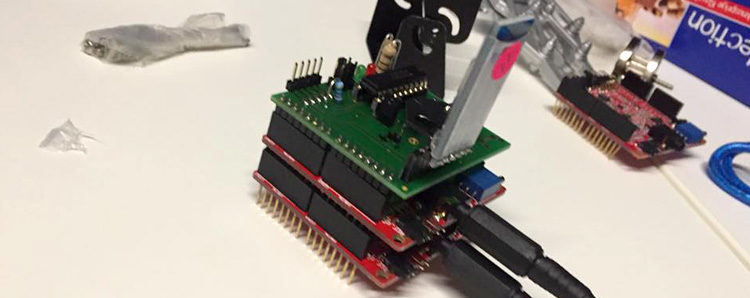
In cooperation with the “GI-Fachgruppe Be-Greifbare Interaktion”, the HCI group at the University of Stuttgart organized the annual Inventors-workshop with the topic: Using Physiological Sensing for Embodied Interaction. In the workshop, we introduced the basic concepts for sensing of human muscle activity accompanied by a refreshing Keynote from Leonardo Gizzi. We provided a basic explanation of how physiological sensing works, introduced how it can be technically realized, and showed different applications and usage scenarios.

IEEE VIS 2016 in Baltimore

IEEE VIS 2016 in Baltimore

This year, the IEEE VIS conference took part in Baltimore, Maryland which is also dubbed ‘Charm City’ by the locals. The conference was held in the Baltimore Convention Center, at the Hilton Hotel. The location is situated not far from the Inner Harbor of Baltimore, a very nice and scenic place. The conference consists of three tracks (InfoVis, SciVis & VAST). Additionally, there are many workshops and tutorials.

Conference Report from VMV 2016

Conference Report from VMV 2016

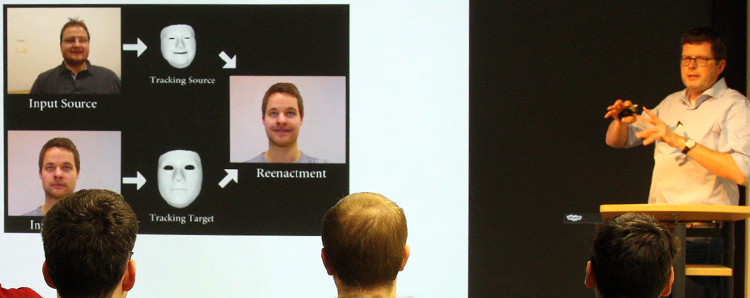
This year’s 21st Symposium on Vision, Modelling and Visualization (VMV) was hosted by the University of Bayreuth. International scientists presented their newest research in various sessions related to Visual Computing. Dr. Fabian Beck, member of the Visualization Research Center of the University of Stuttgart (VISUS) and associated to SFB-TRR 161, presented his interesting work on a matrix-based visual comparison of time series sports data. As part of the VMV 2016, the SFB-TRR 161 co-organized a workshop session titled “Quantification – useful and needed?”. Three leading german researchers of the visual computing community were invited to present their take on the role of quanitification in their respective fields of expertise.

A Short Research Trip to VISUS

A Short Research Trip to VISUS

This summer was a bit different to me than for the rest of my colleagues at Visual Analytics and Imaging (VAI) Lab Stony Brook University and SUNY Korea, as I spent it in Visualization Research Center of the University of Stuttgart (VISUS) for a short research trip. I got this opportunity through the PhD fellowship program, offered by the Transregional Collaborative Research Center (SFR-TRR) 161. I carried out my research in Stuttgart, with many Ph.D.’s and Post-Doc’s at single place and which was definitely a learning experience for me. The whole experience was very different for me but indeed fruitful.

Back from SAP 2016 and SIGGRAPH 2016

Back from SAP 2016 and SIGGRAPH 2016

Last month I had the pleasure to attend the conferences SAP 2016, an international conference on applied perception, and SIGGRAPH 2016, the top conference for Computer Graphics and Interactive Techniques, in Anaheim, USA. Both conferences were co-located to promote the communication between the core perception and computer graphics communities. At SAP I presented my work “Emotion Recognition in Autism Spectrum Disorder: Does Stylization Help?” Afterwards I hat the chance to attend SIGGRAPH.

Provenance: On and Behind the Screens

Provenance: On and Behind the Screens

Melanie Herschel and I gave a tutorial at this year’s ACM SIGMOD conference in San Francisco. ACM SIGMOD is one of the important conferences in the field of data engineering and management. Our tutorial with the title “Provenance: On and Behind the Screens” covered the two topics provenance and visualization, and discussed how provenance information can be visualized.