
I am delighted that I successfully defended my Ph.D. thesis, “Measure-Driven Visual Analytics of Categorical Data,” on July 17th, 2024, as part of the research project A03 of the SFB-TRR 161.
A key challenge in Visual Analytics is the effective analysis and visualization of categorical data—data consisting of discrete labels without inherent numerical order or scale. Unlike numerical data, categorical data, such as “yes” and “no” or “red” and “blue,” cannot be processed using arithmetic operations or many common visualization techniques. Thus, revealing meaningful patterns through visualization, supporting data exploration, or integrating categorical information into visual data mining workflows is difficult. Yet, categorical data is crucial in many fields, including biology, linguistics, and software engineering, where understanding differences between groups and identifying relevant attributes is vital.

My research addresses these challenges by introducing measure-driven approaches that improve the readability of visualizations and extend analytical techniques typically reserved for numerical data. These approaches provide a way to derive meaningful numerical abstractions from categorical data, enabling the application of traditional data analysis methods to categorical data, thus improving data exploration and understanding. By bridging the gap between qualitative and quantitative data, my work enables exploratory data analysis, better integrating categorical data into data analysis workflows across various domains by itself and alongside numerical data.
My thesis tackles this problem in three concrete ways:
- It introduces new quality measures to enhance the Parallel Sets visualization and guide the exploration of categorical data through meaningful attribute projections.
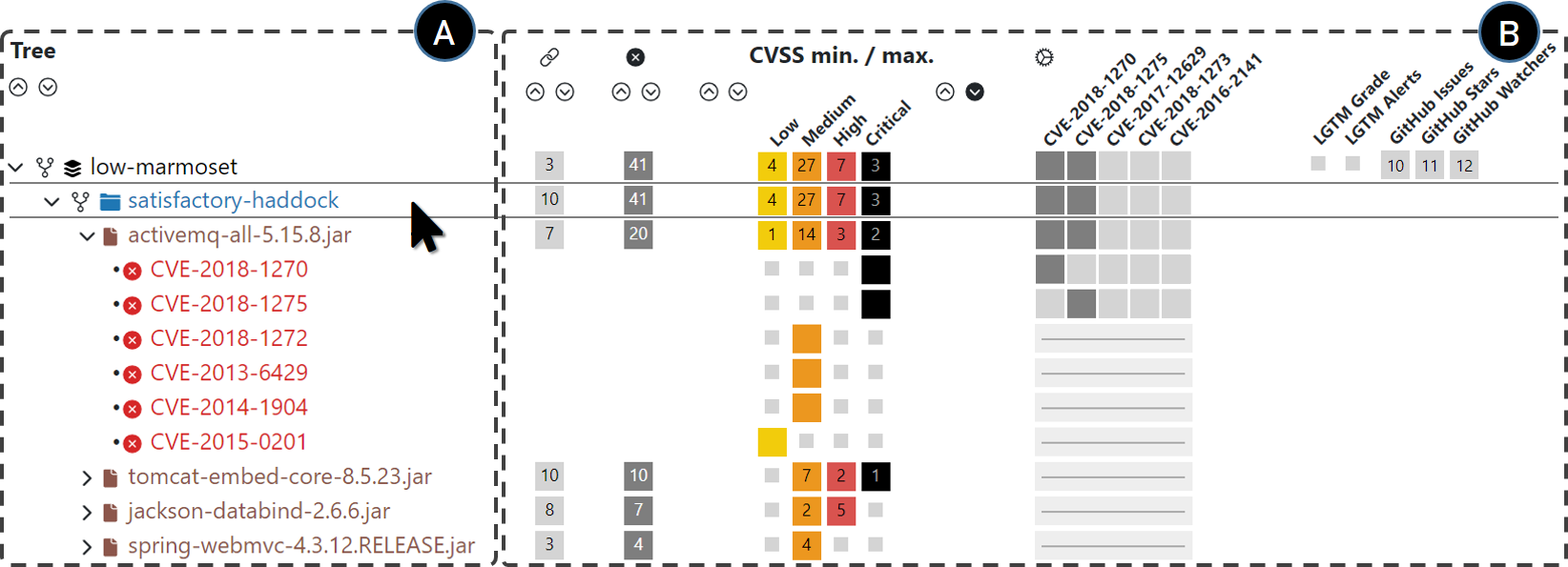
- It explores domain-specific strategies for deriving numerical representations of categorical data with practical applications in linguistics and software engineering.
- It addresses the joint analysis of categorical and numerical data, proposing new strategies for integrating categorical attributes into model training and exploratory frameworks for visual data analysis.

Throughout my research, I strongly emphasized improving the readability and interpretability of visualizations, effectively quantifying patterns, and providing better user guidance in analysis workflows.

I’ve been fortunate to collaborate with outstanding coauthors and mentors whose support has been crucial to the success of this project. I would particularly like to thank Matthias, Thilo, and Max. I am deeply grateful for the continuous support and mentorship from my advisors, Daniel Keim and Tobias Schreck, and for the German Research Foundation (DFG) funding through the SFB-TRR 161.
With the completion of this milestone, I look forward to continuing research at the intersection of visual analytics, data mining, and human-computer interaction, further pushing the boundaries of how we interact with and understand complex data.
Thank you all for your support throughout this journey!
